



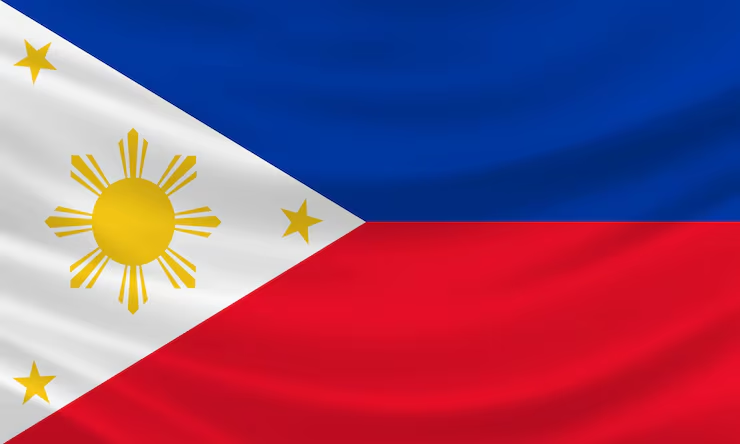
One of Southeast Asia’s most active digital payment markets, the Philippines has emerged with fintech reforms and experiments over the years. With millions of users relying on mobile wallets, QR-based payments, and online banking, businesses now have a well connected access to this highly efficient financial ecosystem.
These transforms haven’t been incidental, they revolve around two major systems GCash and QR PH which have made digital payments faster, more accessible and more convenient for consumers and businesses both.
A new chapter has also been added to the way payments work here, for businesses handling international transactions, combining stablecoins such as USDT with local payment methods opens new opportunities for seamless cross-border collections and payouts.
In this article, we shall explore the touchpoints to all these aspects, most importantly USDT payouts and collections using GCash and QR PH while leveraging local banking infrastructure and modern payment methods.
The Embracing of Digital Payments in Philippines
The Philippines has experienced a significant growth in digital finance services in the past decade. Several factors are driving this adoption, some of the highlights of which include the following:
- Increased smartphone penetration
- Remittance flows
- Growth of the freelancer and creator economy
- Government support for digital and cashless economy
Today, consumers regularly use mobile wallets, bank transfers and QR payments for their everyday transactions, and for global and local businesses, connecting these dots for their consumers can really make their collections and payouts efficient.
Understanding a USDT Payout
A USDT payout refers to distributing funds using Tether (USDT), which is one of the most trusted stablecoins in the world.
Businesses commonly use and trust USTD payouts for the following:
- Freelancer payments
- Marketplace settlements
- Vendor settlements
- Affiliate commissions
- International payroll
- Cross-border supplier payments
Stablecoin-based settlements can help reduce delays which are often associated with traditional transfers, and USDT payouts facilitate that through many digital mediums, which we shall unfold further.
Decoding GCash
GCash in the Philippines is the leading mobile wallet platform and one of the most popular digital payment solutions in the country. Millions of users in the present day rely on GCash for:
- Peer-to-peer transfers
- Online purchases
- Bill payments
- QR code payments
- Merchant transactions
Businesses looking to collect payments from Filipino customers often prioritise GCASH because it is what the users want to go for.
Quick question, can GCash pay through QR PH?
Yes, GCash users can make payments through QR PH, enabling a conformity layer between participating banks as well as e-wallet providers. This gives rise to a more seamless experience for both merchants and customers.
What is QR PH?
QR PH is the country’s QR payment standard. Similar to other national QR systems used across Asia, QR PH enables consumers to make payments using a single QR code regardless of their banking or wallet providers.
The benefits of this system include the following:
- Faster payment collection
- Reduced checkout friction
- Improved customer experience
- Greater interoperability
- Increased digital payment adoption
Is QR PH the same as a GCash QR code?
Not really. In simple words, a GCash QR code is specific to its GCash ecosystem, while QR PH is designed as a broader standard system connecting various banks and payment providers. Both serve similar purposes in different spectrums.
If interested to know more about QR PH, head here.
Using USDT for Cross-Border Collections and Payouts
Businesses operating globally often face common challenges such as high wire transfer fees, delayed settlements, currency conversion costs and tediously numerous banking intermediaries.
Stablecoins like USDT provide an alternative settlement later that can fill these gaps while allowing businesses to distribute funds locally through wallets and banks.
This adds real value for the:
- Global marketplaces
- SaaS platforms
- Remote workforce providers
- Affiliate programs
- International merchants
Receiving money in the Philippines is not as complex as it looks; combining the right payment rails and infrastructure combinations can bring out the best systems for a business operating both locally and globally. Read our guide to find out exactly how! (Note designer: please create the following graphic)
Local Banking Infrastructure in the Philippines
Bank transfers remain an important to the Philippines' financial ecosystem alongside mobile wallets and the popular ones include
It’s one of the Philippines' largest banks supporting both consumer and business banking services, making it a very important player.
It’s a major financial institution mainly involved in serving retail and corporate customers nationwide.
The bank supports international banking and global payment operations.
This one is known for facilitating international trade and financial services throughout Asia.
Combining stablecoin settlements with local banking infrastructure allows businesses to provide recipients with familiar payout options, giving the flexibility and affordability of payout options.
Popular Payment Methods Other Than Banks
The Philippines supports a diverse range of digital payment solutions which sit well with the banking infrastructure as well as international entry points.
A widely used wallet which is a part of the Grab ecosystem.
This one is most popular among e-commerce shoppers and merchants.
This is also an important payment option for international commerce and cross-border transactions.
Supporting multiple payment options and methods can improve payment success rates, customer conversion and satisfaction metrics.
Also learn in detail about how to receive USD payments in the Philippines using GCash, QR PH, and local banks.
How TransFi Simplifies USDT Payout and Collection in the Country
Managing multiple payment channels across borders can be very complex and TransFi understands and solves for that. It helps businesses simplify collections and payouts through:
- Stablecoin-Powered Infrastructure
Enable efficient cross-border settlements using USDT, USDC and other digital currencies.
- Local Banking Access
Access to wallets, banks, and QR code locally used systems through unified infrastructure.
- Simplified Collections and Settlements
Accept customer payments through familiar local payment methods for both users and businesses.
- Scalable Global Reach
Support international businesses while maintaining local payment expertise and reach in both spectrums.
This means that with TransFi, you can now send money to the Philippines, receive money from the Philippines and access a number of online payment processors as well. This really streamlines whichever flow of money one is looking for.
It’s important to not miss out this important aspect of transactions internationally
Exchange rates have a significant impact on international payment costs. Businesses managing regular payouts should monitor fluctuations closely and keep an active eye on the live exchange rates.
Conclusion
The Philippines already offers a very mature and rapidly evolving digital payment ecosystem powered by GCash, QR PH, and banks, as well as mobile wallets.
By combining USDT payouts and collection capabilities with trusted local payment methods, businesses can reduce transaction friction and improve settlement speed as well as create better and local experiences for the customers and business facilitators.
And with TransFi’s global payment infrastructure, organisations can seamlessly achieve this and overcome gaps in stablecoin settlements and local payments across the Philippines.
FAQs
- Is USDT for payouts and collections legal in the Philippines?
USDT is a commonly used asset in the digital asset ecosystem and is subject to local regulations and general compliance requirements.
- Is a QR code still required in the Philippines?
The QR code remains an important part of the Philippines' payment ecosystem and is supported across the country and still makes one of the most commonly used payment methods by the locals as well as the foreigners.
- Does GCash support USDT?
GCash primarily operates as a digital wallet and a payment platform. USDT-related services depend on integrations and regulatory frameworks. Platforms like TransFi become the middle step to support USDT and other digital currencies through GCash.
- What are the benefits of using USDT for payouts?
USDT helps improve the overall settlement efficiency. It reduces a lot of transfer friction and completely supports global operations and expansion.
.png)










.avif)
.avif)
.avif)