








Stablecoin to fiat settlement has become a key connection between blockchain-based assets and traditional finance. It is increasingly necessary for treasury operations, cross-border payments, and the financial system as a whole to be able to seamlessly convert stablecoins for fiat currency and vice versa. This is because a growing number of companies are using digital assets.
This article explains how stablecoin settlement works, what on/off ramps are, and how businesses use these systems to do their regular financial tasks.
What do you mean by "Stablecoins"? (Types of Stablecoins and Examples of Stablecoins)
Stablecoins are digital currencies that are tied to stable things, including fiat currencies like the euro and the US dollar. They preserve the nice features of blockchain, like how fast it is and how you can program it, but they make it more stable.
There are many kinds of stablecoins:
- A stablecoin that is backed by Fiat (fiat-collateralized):
- At a 1:1 ratio, backed by fiat reserves
- Some examples are USDC, USDT, and PYUSD
- Most frequent way to pay
- Stablecoins that are backed by cryptocurrency:
- Using digital currency as security
- Too much collateral to handle volatility
- Stablecoins based on algorithms:
- Instead of reserves, use supply and demand.
- More risk because the design is complicated
It's good to know that stablecoins backed by fiat account for more than 90% of the market valuation. This means that they are the most significant parts of systems that turn stablecoins into fiat.
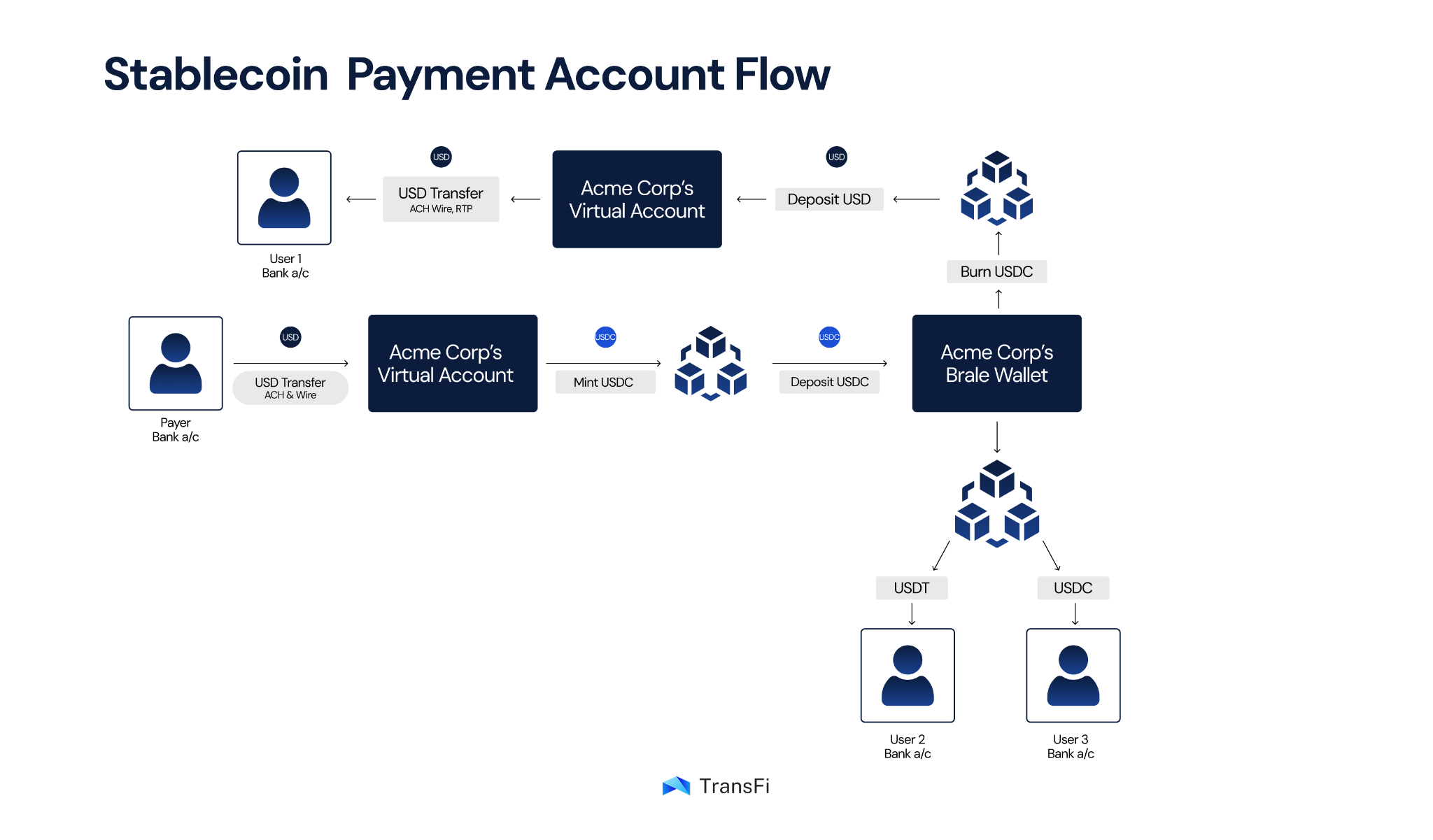
Stablecoin to Fiat Settlement: How Does Stablecoin Settlement Work?
There are two basic ways to change stablecoins into real money:
1. On-Ramps (From fiat to stablecoin)
People can use conventional money to acquire stablecoins on an on-ramp.
Steps:
- The user completes the KYC/AML verification.
- You can put money into your account via bank transfer, credit card, or payment API.
- The provider either transfers stablecoins to the wallet or gives them to it.
Used for:
- Getting started in the crypto markets
- Getting compensated for DeFi work
- Payments for business across borders
2. Off-Ramps (from Stablecoin to Cash)
Users can turn stablecoins into cash with off-ramps.
Steps:
- The user gives stablecoins to the service.
- Provider sells assets through groups of money.
- The money goes into a bank account.
Used for:
- Paying people to work
- Paying suppliers
- Managing the treasury
Important Facts:
This whole solution connects blockchain networks to banking APIs, which makes sure that transactions are settled in real time with compliance layers.
Where to Use Stablecoins Backed by Fiat to Make Payments
Stablecoins are being used in progressively more financial processes:
1. Sending money from one country to another:
- The time it took to settle went from two to five days to just a few minutes.
- Takes out the middlemen
2. The Company's Treasury:
- Companies have stablecoins on hand to help them keep track of their financial flow.
- Let money go throughout the world right away.
3. Providers of Payment Services (PSPs):
- Give businesses stablecoin tracks
- A lot less money is spent on transactions
Data Insight:
Stablecoins are growing more popular for payments between businesses since they process $9 trillion in transactions per year.
How Banks and Payment Processors Use Stablecoins
Banks and other financial companies are putting stablecoins into their systems:
- APIs for connecting on- and off-ramps
- Automating smart contracts
- Layers for settling more than one type of currency
Real-World Example:
- Visa made it feasible for USDC to settle through Solana.
- Get faster clearing and availability for 7 days
- settlement amount of more than $3.5 billion
TransFi (Ramp Infrastructure): Easy-to-integrate products
TransFi and other stablecoin networks prioritise ramp infrastructure (on/off ramps) over wallet services for businesses looking to adopt stablecoins.
The main features are:
- Throughout the world, you can change money from fiat to crypto and back again.
- Businesses can use built-in APIs.
- Payout systems that can work with more than one currency
- Layers of KYC/AML that are ready to follow the rules
Explore Now: If you're developing a finance solution, using ramp-first infrastructure like TransFi can make it a lot easier to connect things.
Get started right away with TransFi Checkout: Sign up
Advantages of Stablecoin to Fiat Settlement
1. How fast and easy
- Settlement every day of the year, all the time
- It merely takes a few seconds to do a transaction.
2. Cost-Effectiveness
- Sending money the old-fashioned way costs roughly 6%.
- Fees for stablecoins are usually less than 1%.
3. Being honest
- Keeping track of a public record
- Seeing things as they happen
4. The skill of writing code
You can do the following with smart contracts:
- Payments that happen without you needing to do anything
- Settlements with conditions
Quote:
“Stablecoins are not just digital dollars, they are programmable financial infrastructure.”
How Do Fiat-Backed Stablecoins Actually Stay Stable?
This keeps everything steady:
- 1:1 support for reserves
- Holdings in: Cash and Treasury bills
- Regular confirmations
But there are still risks:
- Banking vulnerability, like what happened when the SVB went down
- When things are tough, liquidity doesn't add up.
Risks and Issues Associated with Integrating Stablecoins into Payment Systems
1. The laws that control stablecoins
- Rules around the world are broken up
- The EU's MiCA and the US's rules that are changing
2. Risks to business
- Deals that can't be changed
- Issues with smart contracts
3. Splitting up the market
- There are more than 200 stablecoins.
- Problems with compatibility between chains
4. Risks of Redemption
- Not many legal claims on reserves
- Putting faith in the issuer to be honest
Is it possible to turn stablecoins into cash?
Yes. This is what off-ramps are for.
But conversion depends on:
- Cash on hand
- Banks working together
- Following the regulations
How do businesses make money with stablecoins?
Here are some examples of revenue models:
- Costs of doing business
- FX spreads
- Return on assets kept in reserve
- Costs for putting together APIs
Growth in B2B Payments, PSP Networks, and Corporate Treasury
Stablecoins are quickly gaining popularity in:
- Payment networks for businesses
- Operations of the corporate treasury
- Ecosystems for PSPs all around the world
Predictions for the market:
- There will soon be $400 billion in circulation
- The market might be worth $2 trillion in a few years.
The Future of Stablecoins: Connecting with Traditional Financial Systems
1. Greater infrastructure and greater compliance:
- Better approaches to keep things safe
- Institutional quality liquidity
2. Clearer rules and more trust in institutions:
- Frameworks that help people trust each other
- More banks are getting involved.
3. The rise of embedded finance:
Stablecoins that are part of:
- Neobanks
- Payment apps
- SaaS platforms
Need to Know:
Stablecoins account for less than 1% of global money flow; they remain a modest share of it. There is a lot of room to expand.
Conclusion
Stablecoin-to-fiat settlement is transforming the way money travels around the world by making it faster, cheaper, and more customisable. Fiat-backed stablecoins are increasingly more popular, and solid on/off ramp infrastructure is making it easier for decentralised systems and traditional banks to work together.
There are still challenges to solve, notably with regulations and compatibility, but the route forward is apparent. Stablecoins are evolving from being niche cryptocurrencies to being essential aspects of the financial system.
TransFi Checkout is ready for you to use right now: Sign Up
FAQs:
1. Is fiat money a stablecoin?
No, they are digital tokens that are linked to actual money but can't be used to pay for things.
2. How do stablecoins work?
You can switch between fiat and stablecoins using its on-ramps and off-ramps.
3. Is it possible to turn stablecoins into cash?
Yes, through off-ramp companies that deliver money to bank accounts.
4. What kinds of stablecoins are the most popular?
Stablecoins that are based on fiat money, cryptocurrencies, or algorithms.
5. What makes stablecoins so useful for payments?
They make it easy and cheap for users to send and get money, and they can be designed to work anywhere in the world.
.png)












.avif)
.avif)



.avif)