








Cross-border stablecoin payments are quickly becoming a better way to send money across borders than traditional methods. Blockchain technology and digital assets that are linked to actual money make it easier, faster, and cheaper for businesses to transmit money throughout the world. More and more individuals are seeing stablecoins as a useful option to do business across borders in real time, as the limitations of traditional correspondent banking become obvious.
What Are Stablecoin Cross-Border Payments?
Stablecoin cross-border payments employ blockchain-based digital assets that are tied to real-world currencies like the US dollar to move money between nations. These payments settle instantly on the blockchain, which means there are no middlemen like there are in traditional banking.
In short, stablecoin cross-border payments let businesses transmit money to other countries in minutes instead of days, and the costs stay the same.
The Rise of Cross-Border Payments
Most of the time, traditional methods use SWIFT infrastructure and banking through correspondents. They are outdated, but they are also reliable.
- It takes three to five business days to settle.
- Costs are increased by using several middlemen.
- Lack of transparency makes reconciliation take longer.
Businesses face liquidity constraints as a result of these inefficiencies, particularly in emerging markets.
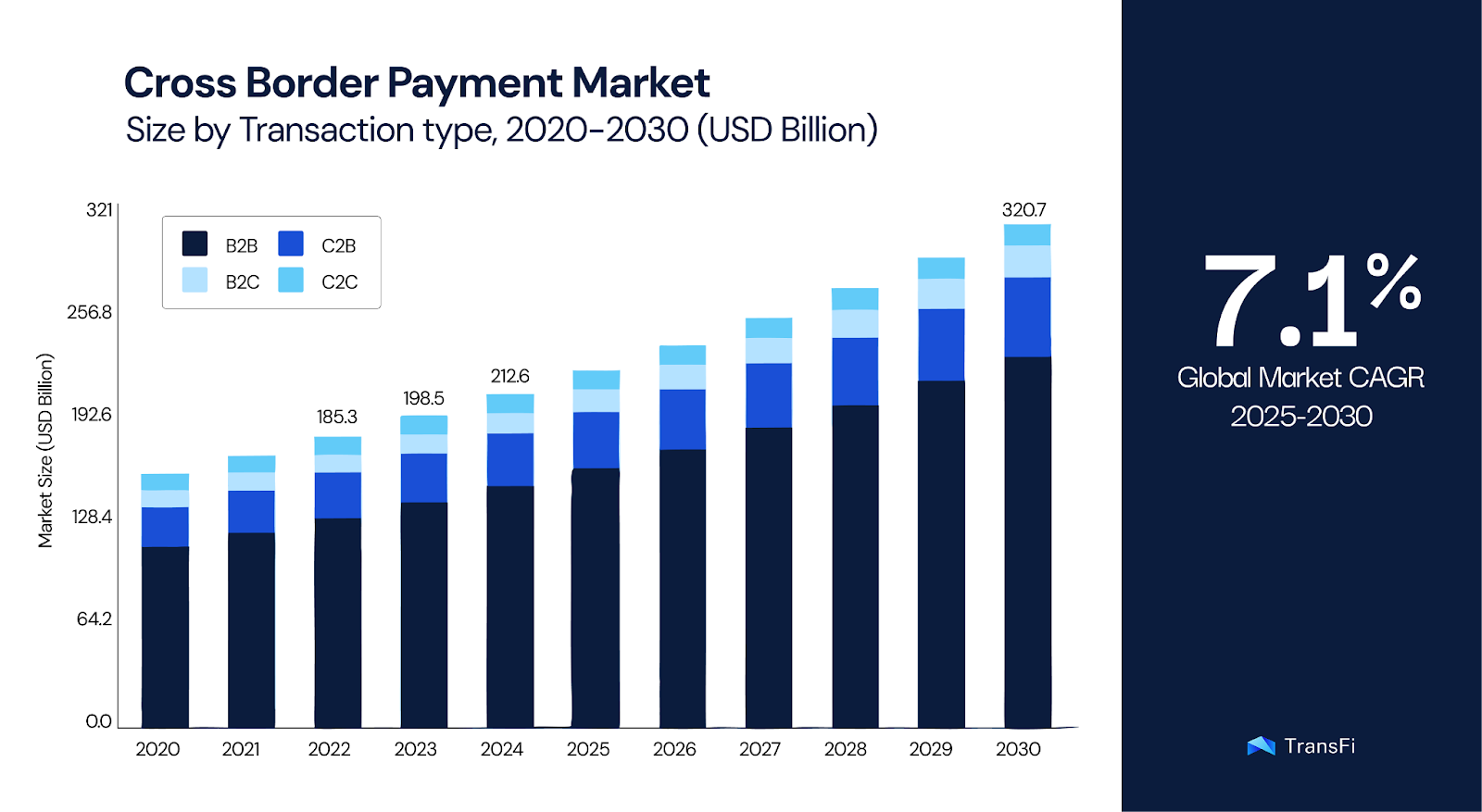
Cross-Border Stablecoin Payments as a Modern Option
What are stablecoins?
Stablecoins are digital assets that are backed by reserves like these and are pegged 1:1 to fiat currencies:
- Cash equivalents
- Short-term government bonds
- Treasury bills
What are the four types of stablecoins that the Treasury sends out?
- Fiat-backed, like USDT and USDC
- Collateralised with cryptocurrency
- Stablecoins that work with algorithms
- Stablecoins backed by commodities
Fiat-backed stablecoins are the most common sort of stablecoin for cross-border transactions since they are stable and have explicit restrictions.
Speed & Efficiency
Payments made with stablecoins across borders settle almost instantly:
- Ethereum: About 15 seconds
- Solana: About 400 milliseconds
- TRON: Less than 2 seconds
This is a major change from SWIFT's delays of several days.
Important benefit: Faster settlement makes working capital more useful, which means businesses can quickly reinvest money.
Cost Reduction
Traditional international payments include:
- Fees for transfers
- Bank fees for correspondents ($10–$25 each)
- FX markups (up to 97% of the total cost)
For example, the person who gets the $5,000 invoice might only get $4,900 or less.
On the other hand:
- Fees for stablecoins: 0.1%–0.5% overall
- No hidden FX spreads
- Minimal intermediaries
Insight: Businesses using stablecoins can save 10–20% on costs, according to EY-Parthenon.
Programmability & Transparency
Traditional systems don't have real-time tracking or reconciliation. Stablecoins use the blockchain to fix this
Main Advantages:
- On-chain auditability
- Tracking payments in real time
- Automatic reconciliation
What Smart Contracts Can Do:
- Payments with conditions (release when delivered)
- Settlements that include multiple parties
- Currency conversion that happens automatically
This makes it a lot easier for financial staff to execute their responsibilities.
Growth Trends & Market Adoption
There is a steep curve for people to adopt:
- By 2025, payments made with stablecoins will be worth $390 billion.
- Payments between businesses rose by 733% from one year to the next.
- Around 60% of the total amount
Forecast: By 2030, stablecoins might be used for 5–10% of all cross-border transactions.
Major modifications in the ecosystem:
- Visa: $4.5 billion in stablecoin settlements every year
- Stripe: Stablecoin payments are available in over 100 countries.
- Shopify: USDC is now available for merchants
Regional Breakdown of Stablecoins for International Payments
Asia-Pacific:
- $245 billion in volume (60% worldwide share)
- A lot of individuals in Japan, Hong Kong, and Singapore utilise it.
- High fintech readiness
North America:
- $95 billion in volume
- Clarification of rules based on the GENIUS Act
- Institutions are adopting it more quickly.
Europe:
- Compliance is driven by MiCA regulations.
- The growth of EUR stablecoins
Latin America & Africa:
- Areas with a lot of growth
- Stablecoins serve as both a payment rail and a store of value
What Are the Benefits of Paying with Stablecoins?
The best benefits are:
- Settlements happen faster, in minutes instead of days.
- Lower costs of transactions
- Available all over the world
- Available 24/7
- More transparency
- Transactions that can be programmed
What Obstacles or Risks Do Stablecoins Have?
There are still challenges, even though there are good things:
1. Breaking the regulations
Different jurisdictions make it harder to follow the rules.
2. The possibility of changing currencies
In emerging markets, stablecoins could make local currencies less stable.
3. Concerns about illegal activity
- The majority of the activities are legal (99%).
- Stablecoins are utilised in 60% of all unlawful cryptocurrency trades, nevertheless.
4. Problems with interoperability
Having more than one blockchain can generate fragmentation.
5. Reliance on Reserve Resources
To trust, there must be audits of reserves and honesty.
What Are the Components of Cross-Border Stablecoin Transactions?
Most transactions look like this:
- Wallet of the sender
- Blockchain-based network
- Stablecoin asset (e.g., USDC)
- Logic for smart contracts (optional)
- Wallet of the recipient
- Providers of on/off ramps
This architecture cuts out a few intermediaries in banking.
How can Businesses utilise stablecoins to pay for things?
Businesses can use stablecoins in the following ways:
- Gateways for payments
- Infrastructure for wallets
- Integrations with APIs
- Systems for managing the treasury
The Benefits of TransFi: Easy Integration
TransFi and other modern platforms make it easier for individuals to use stablecoins by:
- Easy connection with APIs
- Support for stablecoins in multiple currencies
- Built-in compliance with AML and KYC
- Infrastructure for real-time settlement
A use case example:
A multinational SaaS company used stablecoin rails to shorten the time it took to settle from three days to less than five minutes. Companies that want to expand their business to other countries might want to try out a demo to see if it makes things go more smoothly.
TransFi Checkout is ready for you to use right now: Sign Up
Real-World Use Cases
1. Payments to suppliers in business:
Companies make payments to foreign suppliers instantly, without having to worry about currency exchange rates.
2. Payroll and payments for freelancers:
It only takes a few minutes for teams from other nations to get paid.
3. Contracts for e-commerce:
Merchants take USDC and send it right to wallets.
4. Improving the Treasury's work:
Companies improve their cash flow cycles and get rid of cash that isn't being used.
The Future Outlook
The process is simple:
- Institutions are adopting it more quickly.
- Regulatory clarity is getting better all over the world.
- Enterprise-grade infrastructure is emerging.
Things to watch out for:
- Combining with traditional banking
- Increased interoperability among central banks
- Entering emerging markets
- Smart contracts make automation work better.
Estimate: Stablecoins will develop from a substitute rail to a vital worldwide payment system.
Conclusion
Cross-border payments with stablecoins are revolutionising how money operates around the world. They are more transparent, faster, and more affordable than older systems.
There are still systemic and regulatory risks, but better infrastructure and compliance frameworks are helping to fix these concerns. Stablecoins are going to play a significant part in international trade because numerous companies are employing them, and the industry is growing swiftly.
Visit Now: If you want to accept cryptocurrency payments for your business, a platform like TransFi can help you a lot.
Get started right away with TransFi Checkout: Sign up
FAQs:
1. What is a payment made with a cross-border stablecoin?
This blockchain-based technique to transmit money around the world uses digital assets that are tied to real money to speed up and minimise the cost of settlement.
2. What kind of cryptocurrency will be used for payments between countries?
The most popular stablecoins are USDC and USDT since their prices don't vary.
3. What does it imply to make payments with stablecoins across borders?
These are peer-to-peer transactions that happen on blockchain networks across borders without the need for middlemen.
4. How can companies use stablecoins in their payment systems?
through things like APIs, payment gateways, wallets, and TransFi.
5. What are the benefits of paying with stablecoins?
cheaper costs, faster payments, access from anywhere in the globe, and more openness.
.png)












.avif)
.avif)



.avif)