











Cryptocurrency payment gateways are transforming how businesses accept payments globally. As digital assets gain mainstream adoption, companies are actively exploring how to accept crypto payments securely, reduce transaction fees, and expand into new markets.
Companies of every type, from small startups to big multinationals, are adopting blockchain-based payments to save money, speed up transactions, and reach more people.
Current Landscape: Why Businesses Accept Crypto Payments
People all over the world are starting to use digital currency to buy items. Polls from the last few days reveal that:
- 46% of stores currently take cryptocurrencies as payment.
- At the register, about 40% of US businesses accept cryptocurrencies.
- 88% of adoption is driven by customer demand.
- Some businesses get around 26% of their sales from cryptocurrency.
Key Point: Larger companies are more likely to employ cryptocurrencies since they have more resources and a bigger audience.
“Crypto payments are not just innovation, they are becoming infrastructure.” Industry Analyst Report.
This is clear evidence that financial systems are evolving toward ones that put digital technology first.
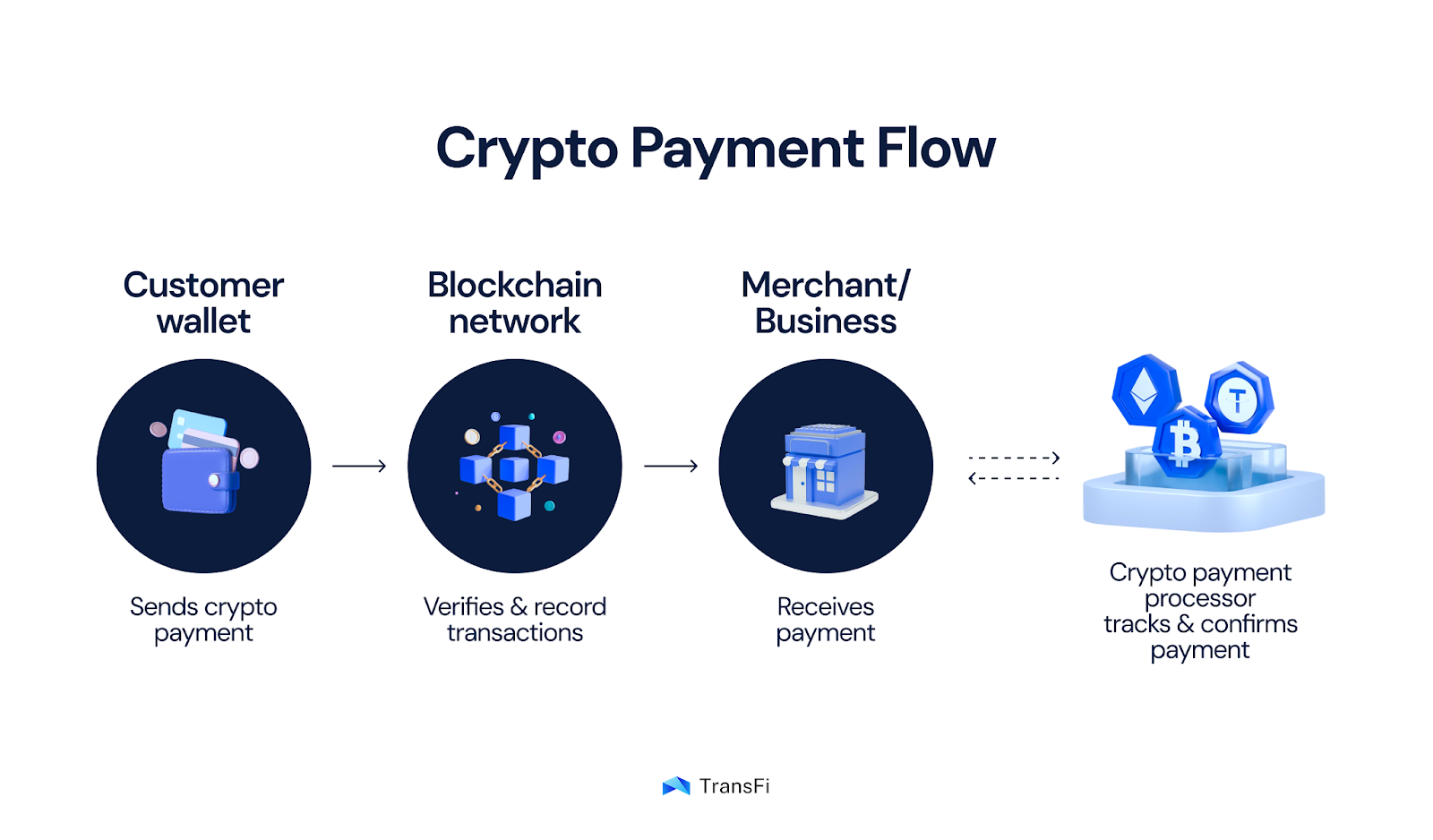
How to Accept Crypto Payments as a Business
Businesses can accept bitcoin payments in three primary ways. Each one has a different level of difficulty, control, and compliance load.
1. Using a Crypto Payment Gateway (Best for Most Businesses):
A cryptocurrency payment gateway makes everything easier. It does the following:
- Creating a wallet address
- Pay using a QR code
- monitoring at the blockchain
- Quick payment (in fiat or cryptocurrency)
- Locking in rates of exchange
Important Information: You don't need to know how to use a blockchain if you have a gateway.
2. Accept cryptocurrency payments with API integration
An Accept crypto payments API helps enterprises that are more advanced connect more deeply.
Here are some of the features:
- Personalised checkout processes
- Automatic billing
- Support for more than one currency
- Monitoring blockchain in real time
This strategy works well for:
- Platforms for SaaS
- Fintech apps
- Online stores
3. Direct Wallet Payments (Self-Custody)
Businesses can also get payments directly into their cryptocurrency wallets.
Advantages:
- Full control over money
- No costs for intermediaries
Cons:
- High level of security responsibility
- Complicated accounting
- Manual reconciliation
Important: This strategy works well for companies that are currently using cryptocurrency.
Top Crypto Payment Gateway Options
Choosing the right cryptocurrency payment gateway depends on scalability, compliance, and settlement preferences.
Important: Some companies want a cryptocurrency payment gateway that doesn't require KYC; this could mean they are breaking the law. Always examine what you need to do to stay in compliance.
Step-by-Step: How to Accept Cryptocurrency Payments
If you're wondering how to accept crypto payments, follow this framework:
- Choose a method (gateway, API, or wallet)
- Select cryptocurrencies (BTC, ETH, USDT, etc.)
- Integrate checkout experience
- Enable fiat conversion (optional)
- Implement KYC/AML compliance
- Train finance and support teams
This answers essential questions like:
- How do I receive a crypto payment?
- Can I accept payments in crypto?
Yes, once the infrastructure and compliance are in place.
Launch faster with TransFi Checkout, integrate once, accept globally, and settle instantly in fiat or stablecoins.
The Main Benefits of Accepting Crypto Payments
- Faster settlements and lower expenses:
Traditional processors take 3% to 4% of each transaction as a fee.
If you pay using crypto, this can go down to less than 1%.
- Time spent settling: minutes instead of days
- No middlemen
- Better cash flow
- No chargebacks and safety
Cryptocurrency transactions are:
- Immutable
- Transparent
- Irreversible
This reduces chargeback fraud, which is a huge concern for online stores.
- Access to International Markets:
You can do the following with crypto:
- Payments that go across borders
- Getting in touch with those who don't have bank accounts
- Make it easy to do business with people in other countries.
Stablecoins enable customers to pay for things around the world in US dollars.
- Brand Positioning and Innovation:
Getting indications from crypto:
- Leading in technology
- Innovation that puts the customer first
- Infrastructure that is ready for the future
Strategic Framework for Accepting Crypto Payments
1. Use Stablecoins for Predictability
- Reduces exposure to volatility
- Makes it easier to do accounting
2. Set up Reporting Systems
Follow:
- Times and dates for transactions
- Fiat equivalents
- Checks on the blockchain
3. Set clear rules for refunds
Let us know:
- Currency that can be refunded (fiat vs. cryptocurrency)
- Talk about how validation works.
- Workflows for customer service
What Makes TransFi Different?
- Exceptional User Experience
TransFi delivers instant transactions, intuitive dashboards, and seamless navigation across fiat and stablecoin flows. Every interaction is designed for speed, clarity, and reliability.
- Optimized, Transparent Fees
Built for efficiency, TransFi offers low, transparent processing fees tailored for stablecoin settlements eliminating intermediaries and hidden costs.
- Enterprise-Grade Infrastructure
Powered by a secure, high-performance network, TransFi ensures 99%+ uptime, fast processing, and superior conversion rates built for businesses operating at global scale.
- Developer-First Integration
Easily integrate stablecoin payments using modern APIs and SDKs. With clear documentation and responsive support, your team can build, launch, and scale faster.
Explore Now: If you want to accept cryptocurrency payments for your business, a platform like TransFi can help you a lot.
Real-World Examples of Crypto Payment Adoption
- E-commerce businesses will accept stablecoins for orders from other countries.
- People from all around the world can use cryptocurrencies to book vacations through travel businesses.
- Cryptocurrency is used by gaming platforms to buy stuff and get prizes in games.
- Freelancers and SaaS companies take crypto to make international banking faster.
A mid-sized SaaS company that started taking cryptocurrency payments witnessed a 35% increase in foreign conversions.
Conclusion
Businesses need to do more than just accept crypto payments on the surface in order to do so successfully. It needs careful planning for money, decisions concerning infrastructure, and being ready to follow the rules.
Cryptocurrency provides genuine benefits, including lower costs, faster settlements, and the ability to access it from anywhere in the world. But you have to take the initiative to deal with operational complexity, regulation, and volatility.
Companies that do successfully will perceive bitcoin as a way to pay, not just a fad. If you're a business owner and want to accept bitcoin payments, start with a restricted rollout. Check your compliance stack, test your gateways, and check your APIs.
In the future, payments will be programmable, work anywhere, and use blockchain technology.
Future Prospects
The expansion of cryptocurrency payments will probably concentrate on:
- Business transactions will be dominated by stablecoins.
- Adoption will increase with regulatory clarity.
- Crypto rails may be integrated with CBDCs.
- Payment companies will combine cryptocurrency and fiat systems.
Analysts say that in five years, cryptocurrency payments could be common for international trade.
Get started right away with TransFi Checkout: Sign up
FAQs:
1. How do I accept crypto payments?
Depending on what your business needs, you can use direct wallet transfers, API integration, or cryptocurrency payment gateways.
2. What is the best way to accept crypto payments online?
The best and most scalable way to do this is to use a cryptocurrency payment gateway or API.
3. How do I receive a crypto payment?
You make a wallet address or a QR code. The client sends cryptocurrency to that address.
4. Can I accept payments in crypto legally?
Yes, but you have to observe the rules in your area, like those governing taxes, KYC, and AML.
5. Is there a crypto payment gateway without KYC?
There are various decentralised solutions; however, most compliant services need KYC because the law says so.






.avif)
.avif)



.avif)