






In the realm of cryptocurrency, stablecoins are now the most significant thing. They connect digital assets that change a lot with money in the real world. Tether (USDT) and USD Coin (USDC) are the most popular ones.
This post goes into great detail regarding both USDC and USDT if you're not sure what they are or which one is better to utilise. We'll discuss real-world uses, compliance, liquidity, and transparency so you can make an informed choice.
What makes USDC and USDT different when it comes to stablecoins?
Stablecoins are digital currencies that are linked to things that don't change, like real money. The U.S. dollar is usually the peg (1:1).
Very important:
There are three key reasons to use stablecoins:
- A place to keep your cash
- How to make a deal
- Unit of measure
You can do the following with stablecoins:
The Main Difference between USDT and USDC
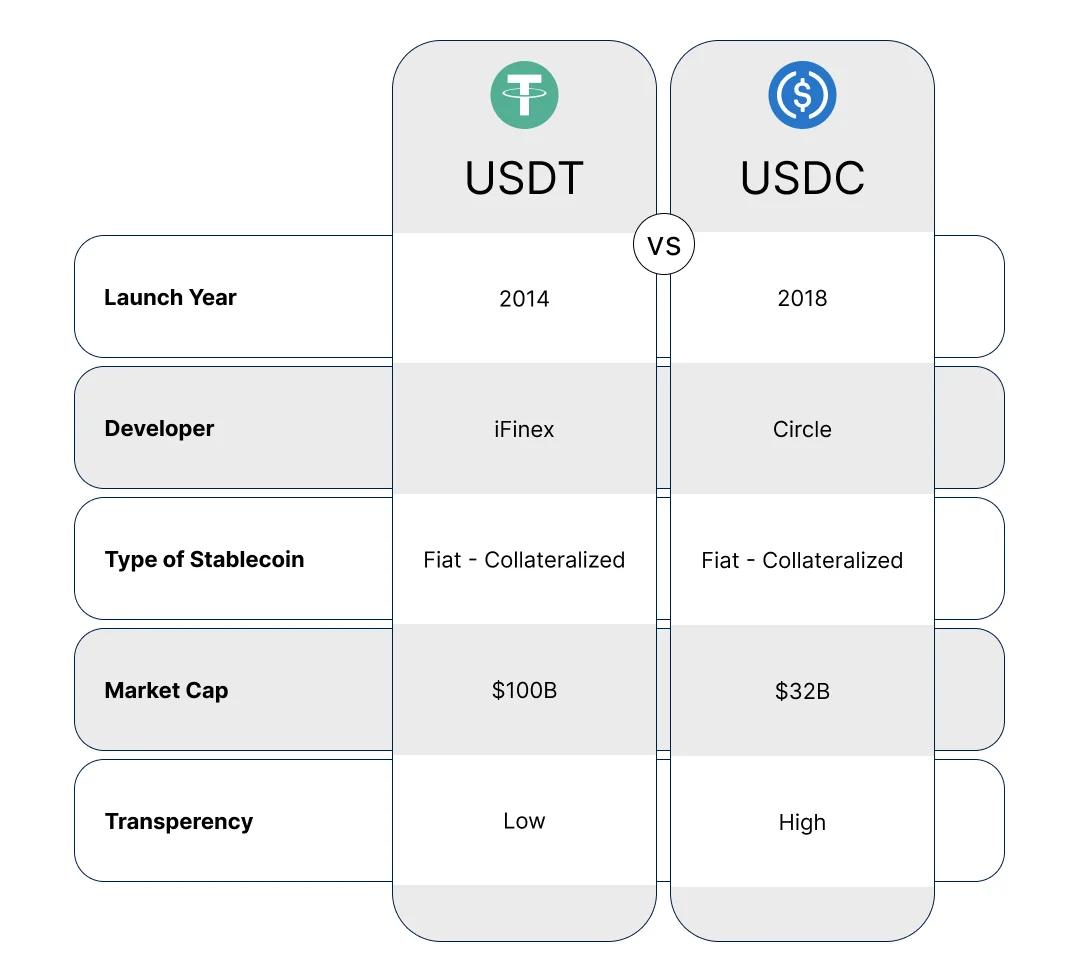
1. Issuer & Structure:
- USDT: Tether Limited is the firm that creates USDT.
- USDC: Coinbase and Circle worked together to make USDC.
2. Reserve Composition:
- USDT: A mix of assets, including loans, Treasuries, and cryptocurrencies
- USDC: Mostly cash and U.S. Treasury bonds that are due in a short time
3. Being transparent:
- USDT: quarterly confirmations and a history of not being clear
- USDC: Every month, companies like Grant Thornton check USDC.
4. Guidelines:
- USDC: Strong adherence to U.S. regulations and compatibility with MiCA
- USDT: A structure in another nation that regulators watch over
5. Market numbers:
- USDT: It has a market valuation of roughly $111 billion and a daily volume of about $50 billion.
- USDC: The market size is at $34 billion, while the daily volume is around $5 billion.
Learn more about Best Stablecoin Payment Gateway for Websites and Global Payments
USDC vs USDT: The Decision Between Transparency and Cash Flow
USDT: The Best for Cash Flow
- All exchanges have rules for trading pairs.
- Best for making a lot of trades in one day
- There is a lot going on with chains like TRON and Ethereum.
TRON transfers of USDT are some of the cheapest in the globe.
USDC: The Asset That Follows the Rules
- Fintechs and other businesses like it
- A lot of trust is placed because the reserves are examined.
- Used a lot in regulated financial contexts
Where People Use USDC and USDT in Real Life
USDC in Payments and Finance Around the World
- More than 100 million people can now use USDC thanks to Nubank and Circle working together.
- USDC on Stellar helps UNHCR support people in need.
- Fintechs in Africa and Latin America utilise USDC to transmit and receive money and keep track of it.
How USDT works in Trading and Cash Flow
- The biggest source of cash flow for bitcoin exchanges is
- Used a lot in derivatives markets and DeFi pools
- Best for fast arbitrage trading
Stablecoins' New Role in Making Payments Across Borders
Stablecoins are changing how people pay for things all across the world by letting them.
- Settlement comes in seconds, not days.
- FX that costs less
- Ways to set up payment flows
TransFi: Making Products Work Together Smoothly
A lot of platforms work in this field, but more and more businesses desire infrastructure instead of distinct tools.
TransFi wants to be the only location you need to go to:
- Stablecoins for payments between countries
- Rails for settling in more than one currency
- Taking care of the treasury as it happens
If you wish to add stablecoins to your business, you should look into TransFi's payment infrastructure, which can grow with your firm.
Find out how utilising stablecoins to pay can alter your business.
Visit Now: Set up a personalised demo with TransFi to find out how to make payments easier, cheaper, and more visible in real time across borders: Sign up.
Advantages and Drawbacks
Benefits of USDT
- A lot of cash flow
- Works with many different exchanges
- Can work with more than one chain
Problems with USDT
- Worries about being open
- Rules that are risky
- A blend of different types of reserves
Benefits of USDC
- Strong audits and being open
- Following the rules
- Organisations that use it
Problems with USDC
- Not as easy to get rid of
- Risks of centralisation
- Using traditional banks
Which three stablecoins are the most stable?
A lot of the market for stablecoins is made up of:
- Tether (USDT)
- The US dollar is USDC.
- DAI is a stablecoin that no one person owns.
Each one has a different use:
- USDT: Trading and moving money
- USDC: Following the rules and paying bills
- DAI: Stands for decentralised finance.
Should I keep USDC or USDT?
It all depends on how you want to use it:
Better Options:
- For Trading and Cash Flow: USDT
- For Payments and Obeying the rules: USDC
- For Institutional Treasury: USDC
- For Trading Arbitrage: USDT
Quote: “Liquidity solves trading problems; transparency solves trust problems.”
What Will Happen to Stablecoins in the Future
Rules, institutions that use them, and new infrastructure will all have an impact on the future of USDC and USDT.
Important Trends:
- The MiCA rule will aid stablecoins in Europe that obey the guidelines.
- The emergence of CBDCs, which are digital currencies from central banks
- Increasing numbers of companies are using blockchain payments.
- More significant when paying for B2B
Stablecoins should become:
- A default layer for settling trades in all parts of the world
- Part of the apps for banking and financial technology
- The most significant feature of Web3's money system
Conclusion
It's not about which one is better for everyone; it's about which one is better for the job at hand.
- USDC is better at being honest, following the regulations, and getting institutions to trust it.
- USDT is superior since it's easy to get to, has a lot of liquidity, and has a lot of market depth.
Businesses could choose to use both, depending on what they need to do.
As stablecoins develop better, systems like TransFi will help people understand and use them more easily.
Are you ready to make your international payment systems easier?
Sign up for TransFi and start utilising stablecoins like USDC and USDT to conduct payments across borders that are faster, easier, and more legal.
FAQs:
1. What do USDC and USDT mean in simple terms?
Both USDC and USDT are stablecoins that are linked to the US dollar; they are not the same in terms of how open, regulated, and liquid they are.
2. Which is better, USDC or USDT?
- Follow the guidelines and pay with USDC.
- Use USDT to trade and make money.
3. What are the risks of using USDT and USDC?
- USDT: Concerns about rules and being open
- USDC: Centralisation and banks are a problem
4. Are stablecoins able to take the role of normal banks?
They operate well together, but they don't replace each other, especially when it comes to payments across countries.
5. Is it okay to hold stablecoins for a long time?
Not as hazardous as crypto that changes a lot, but still has: Counterparty risk and Regulatory risk.
.png)












.avif)
.avif)



.avif)